Check out this song by Stephen Kay & David Alvey. For a tribute to Challenger space shuttle (STS-51L) nearing it's 25th Anniversary.
January 22, 2011


January 18, 2011
APOD: 2011 January 17 - Night and Day above Almost Planet Sounio
APOD: 2011 January 17 - Night and Day above Almost Planet Sounio
Check out this picture by Chris Kotsipoulos
Credit & Copyright - Chris Kotsipoulos
January 15, 2011
Deep Space Radar Unveils Rotating Asteroid 2010 JL33
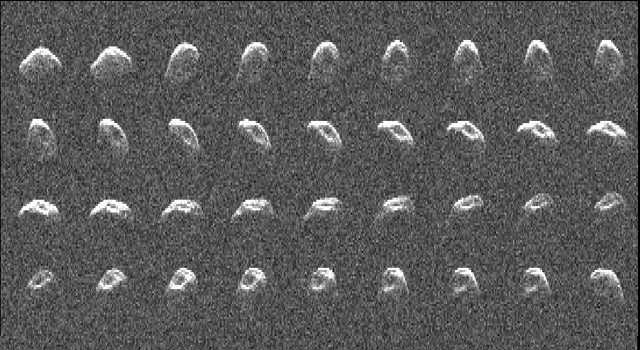
A radar image of asteroid 2010 JL33, generated from data taken by NASA's Goldstone Solar System Radar on Dec. 11 and 12, 2010. Image credit: NASA/JPL-Caltech
Intriguing details about the physical properties and characteristics of a recently discovered asteroid have just been unveiled in amazing images obtained using a large radar dish in California. The radar dish serves as a key component of NASA’s Deep Space Network (DSN). The Near Earth asteroid, dubbed 2010 JL33, was imaged by radar on Dec. 11 and 12, 2010 at NASA’s Goldstone Solar System Radar in California’s Mojave Desert when a close approach to Earth offered an outstanding opportunity for high quality science.
Update: Orbital diagram added below
A sequence of 36 amazingly detailed images has been assembled into a short movie (click on the title).
The Little Cepheid that Stopped
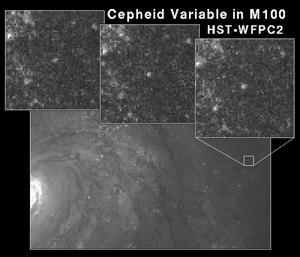
Cepheid Variable Star. Credit: Hubble Space Telescope
When Hubble first discovered a Cepheid variable in the galaxy M31, the universe grew. Previously, many astronomers had held that the fuzzy “spiral nebulae” were small patches of gas and dust within our own galaxy, but through the Period-Luminosity relationship which allowed him to determine the distance, Hubble demonstrated that these were “island universes”, or galaxies in their own right.
Soon after, Hubble (as well as other astronomers) began searching other fuzzy patches for Cepheids. Among them was the spiral galaxy M33 in which he discovered 35 Cepheids. Among them was V19 which had a 54.7 day period, an average magnitude of 19.59 ± 0.23 MB, and an amplitude of 1.1 magnitudes. But according to recent work revealed at the recent American Astronomical Society meeting, V19 no longer seems to be pulsating as a Cepheid.
NASA – The Frontier Is Everywhere (Videos): Readings from Carl Sagan
Check out this awesome pair of inspiring videos about NASA and Space Exploration. They are set to the ever inspiring words of Carl Sagan – reading from his book, “The Pale Blue Dot”. And these beautifully crafted videos were not created by NASA, but rather by people inspired by NASA and Carl Sagan to dream about distant frontiers even in these times of tough budgets for NASA.
Stunning New Images From Cassini’s Close Flyby of Rhea

Rhea, Saturn's rings and some sister moons. Credit: NASA/JPL/Space Science Institute
Jia-Rui C. Cook from the Cassini team sent out an alert that raw images from Cassini’s closest flyby of Saturn’s moon Rhea have begun streaming to Cassini’s raw image page, and they are well worth a look. At closest approach, Cassini came within about 69 kilometers (43 miles) of Rhea’s surface on Jan. 11. But there’s also some interesting group photos from within the Saturn System. One of the best is this image, above. How many moons can you find? I probably wouldn’t have seen them all but Emily Lakdawalla at the Planetary Blog spied five moons and the rings in this one wide-angle shot. The large moon is Rhea; above Rhea and just below the rings, is Dione; above and to the left of Rhea is Tethys. Then there are two tiny moons: squint hard to see Prometheus as tiny lump on the rings to the left of Dione, and Epimetheus is hovering between Tethys and Rhea. See some more, including closeups of Rhea and Saturn’s storm, click on the title.
Universe Today
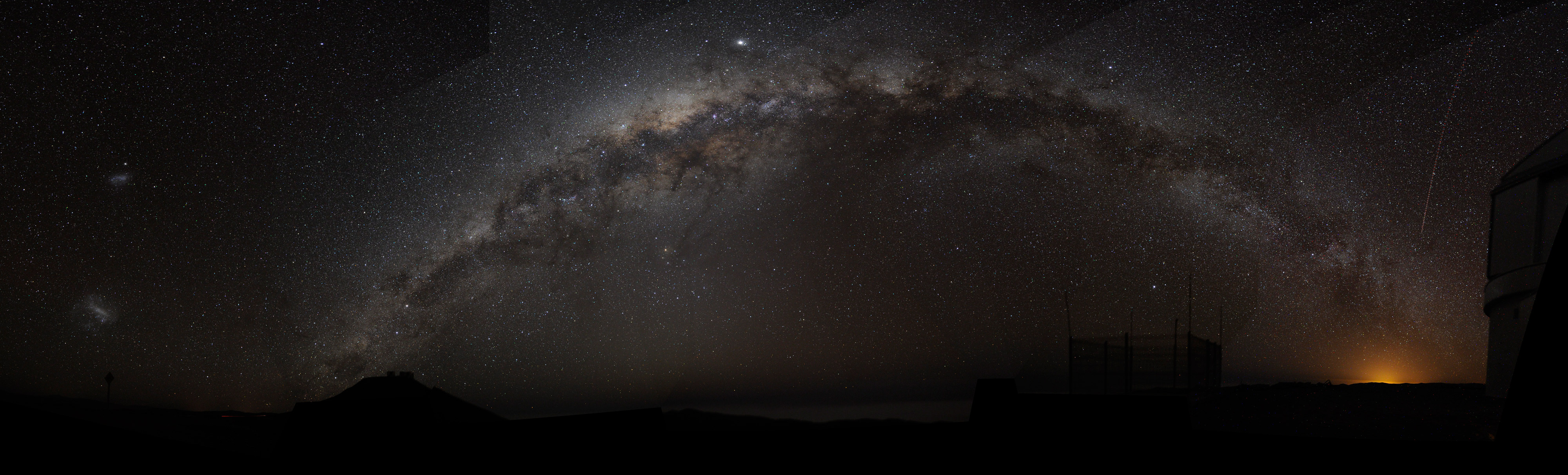
The Milky Way
Not very long ago we published a news release about the latest (and largest) deep sky survey image ever. The implications behind such a massive undertaking at such incredible resolution means you could spend hours studying just a few square millimeters of such a photo and find any amount of undiscovered information. Do professional astronomers have the time to search? Or can anyone have a look? That’s the topic of the latest of the latest American Astronomical Association press release – ESO: Hidden Treasures Brought to Light. Let’s find out.......
Planck Unveils the Wonders of the Universe
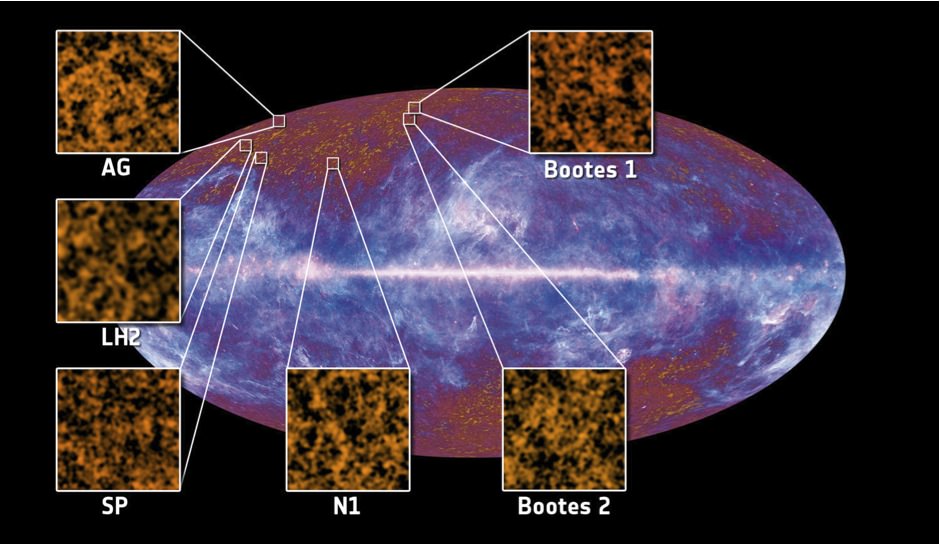
Six areas of the sky in which distant galaxies can be seen by Planck, overlaid on the Planck’s first all-sky image. The emission from our own Galaxy, seen in blue and white, has to be removed before the distant population of galaxies can be seen. Each square inset image is around the same size as the Full Moon. Image credit: ESA / Planck Collaboration.
January 12, 2011
Fermi Telescope Catches Thunderstorms Hurling Antimatter into Space
From a NASA press release:
Scientists using NASA’s Fermi Gamma-ray Space Telescope have detected beams of antimatter produced above thunderstorms on Earth, a phenomenon never seen before.
Scientists using NASA’s Fermi Gamma-ray Space Telescope have detected beams of antimatter produced above thunderstorms on Earth, a phenomenon never seen before.
Scientists think the antimatter particles were formed in a terrestrial gamma-ray flash (TGF), a brief burst produced inside thunderstorms and shown to be associated with lightning. It is estimated that about 500 TGFs occur daily worldwide, but most go undetected.
“These signals are the first direct evidence that thunderstorms make antimatter particle beams,” said Michael Briggs, a member of Fermi’s Gamma-ray Burst Monitor (GBM) team at the University of Alabama in Huntsville (UAH). He presented the findings Monday, during a news briefing at the American Astronomical Society meeting in Seattle......[Click here]
Hubble Eyes Hanny’s Voorwerp
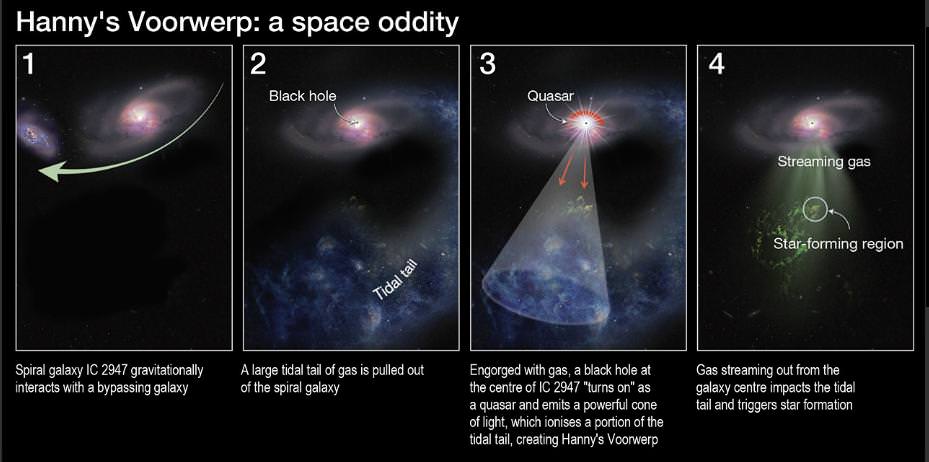
This diagram explains the formation of the strange green object known as Hanny’s Voorwerp. Astronomers believe that it is part of the long streamer of gas that extends from galaxy IC 2497, lit up brightly by the searchlight beam of a recently extinguished quasar.
Almost four years ago a group of astronomers known as the Galaxy Zoo made a very exciting discovery – one they named “Hanny’s Voorwerp”. Although the action occurred a hundred thousand years ago and somewhere in the neighborhood of 700 million light years away, a once upon a time quasar burned brighter than its neighboring galaxy. While the tidal pull of massive spiral IC 2497 shredded a gas rich dwarf galaxy, the incredible outpouring of ultraviolet and X-ray radiation combined with the quasar ignited the gases to light… but what exactly is it? The Hubble Space Telescope turned its eye in the direction of Leo Minor to find out…[Click here]
Hide And Seek…. Supermassive Black Hole Peeks From Behind The Skirt Of A Dwarf Galaxy
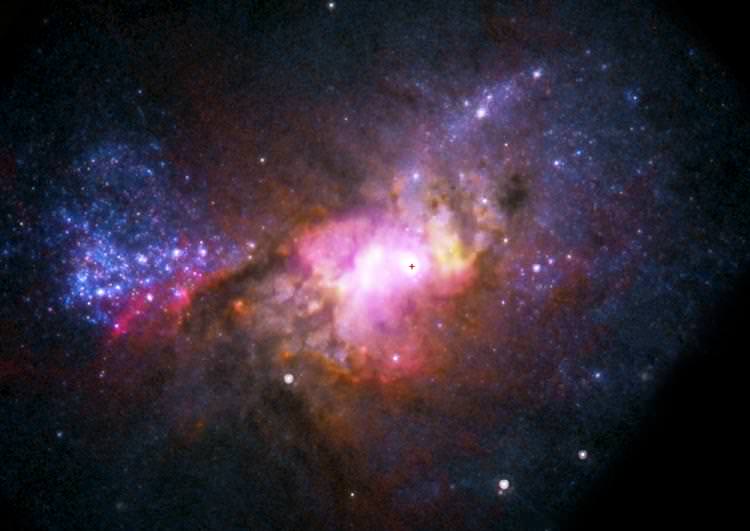
Composite image of the dwarf galaxy Henize 2-10. Hubble Space Telescope data is colored red, green and blue, Very Large Array data is yellow and the Chandra X-Ray Observatory data is purple. Cross marks presumed location of the supermassive black hole in the galaxy.
It’s a bird… It’s a plane… It’s a million times more massive than our Sun! Just how big do you have to be to hide something really big? Well, in the case of a supermassive black hole all you have to be is a small galaxy.
According to the American Astronomical Society Press Release the surprising discovery of a supermassive black hole in a small nearby galaxy has given astronomers a tantalizing look at how black holes and galaxies may have grown in the early history of the Universe. Finding a black hole a million times more massive than the Sun in a star-forming dwarf galaxy isn’t exactly child’s play – but it is a strong indication that supermassive black holes formed before the buildup of galaxies.
January 5, 2011
Hubble Takes a Spectacular Look Inside the Eagle Nebula
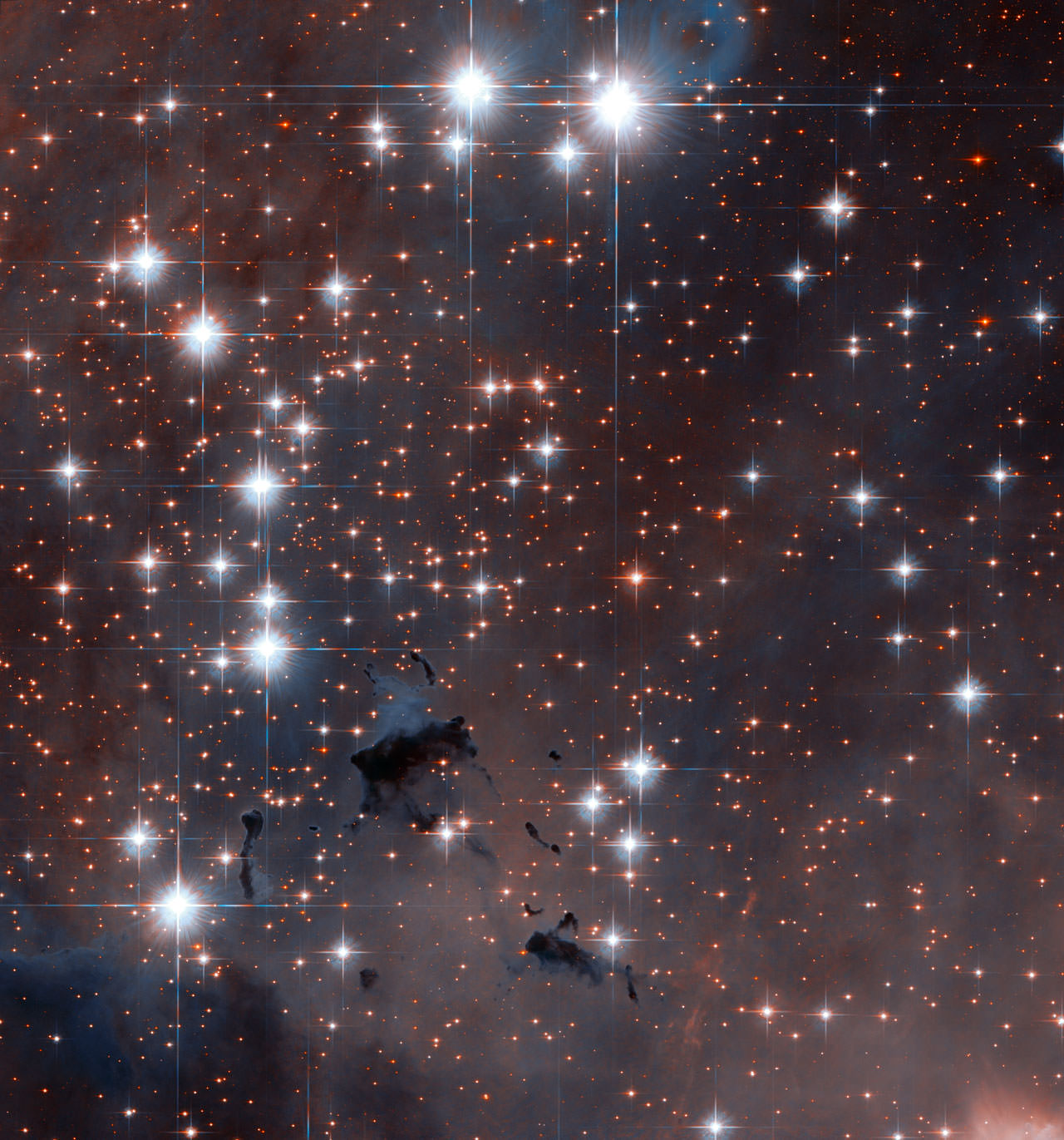
A new look at the Eagle Nebula by Hubble. Credit: ESA/Hubble & NASA
There are some stellar powerhouses inside the Eagle Nebula, and Hubble has captured a collection of these hot, blue stars. These dazzling stars are an open star cluster called NGC 6611, whose fierce ultraviolet glow make the surrounding Eagle Nebula glow brightly. But there are also areas in this image that look dark and empty. Are those areas just empty? No, they are actually very dense regions of gas and dust, which obstruct light from passing through.
Hubble astronomers say that many of these dark areas may be hiding the sites of the early stages of star formation, before the fledgling stars clear away their surroundings and burst into view. Dark nebulae, large and small, are dotted throughout the Universe. If you look up to the Milky Way with the naked eye from a dark, remote site, you can easily spot some huge dark nebulae blocking the background starlight.
[Click here]
[Click here]
January 3, 2011
Sky Calendar -- January 2011
| 1 | Beginning of the second decade of the third millennium. |
| 1 | Moon near Antares (30° from Sun, morning sky) at 20h UT. |
| 2 | Moon near Mercury (21° from Sun, morning sky) at 16h UT. |
| 3 | Earth at Perihelion (closest to Sun) at 19h UT. The Sun-Earth distance is 0.983341 a.u. or 147.1 million kilometers. • Sun at Aphelion and Perihelion (Anthony Ayiomamitis) |
| 4 | Quadrantid Meteor Shower peaks at 1h UT. Active between 1-10 January. Produces up to 120 meteors per hour. Radiant is in northern Bootes. Low moonlight makes for very favorable viewing conditions this year. • The Quadrantids (Gary Kronk) • The Quadrantids (IMO) |
| 4 | New Moon at 9:03 UT. Start of lunation 1089. • Lunation Number (Wikipedia) |
| 4 | Partial Eclipse of the Sun at 8:51 UT. Visible from much of Europe, North Africa and central Asia. Eclipse begins at 06:40, ends at 11:01 UT. WARNING: NEVER LOOK AT THE SUN -- it will instantly damage your eyes! Instead, use a pinhole in a card to project the Sun's image onto a surface. • Partial Solar Eclipse of 2011 January 04 (NASA) • Observing Solar Eclipses Safely (Mr Eclipse) |
| 8 | Venus at greatest elongation, 47° west from Sun (morning sky) at 16h UT. Mag. -4.4. |
| 9 | Mercury at greatest elongation, 23° west of Sun (morning sky) at 14h UT. Mag -0.2. |
| 10 | Moon at apogee (farthest from Earth) at 6h UT (distance 404,977 km; angular size 29.5'). |
| 10 | Moon near Jupiter at 11h UT. Mag. -2.3. |
| 12 | First Quarter Moon at 11:32 UT. |
| 15 | Moon near the Pleiades at 14h UT (evening sky). |
| 16 | Moon near Aldebaran (evening sky) at 8h UT. |
| 19 | Full Moon at 21:22 UT. • Full Moon Names (Wikipedia) |
| 20 | Moon near Beehive cluster M44 (midnight sky) at 9h UT. |
| 21 | Moon near Regulus (morning sky) at 23h UT. |
| 22 | Moon at perigee (closest to Earth) at 0h UT (362,792 km; 32.9'). |
| 25 | Moon near Saturn (morning sky) at 4h UT. Mag. +0.7. |
| 25 | Moon near Spica (morning sky) at 18h UT. |
| 26 | Last Quarter Moon at 12:58 UT. |
| 29 | Moon near Antares (morning sky) at 0h UT. |
| 30 | Moon near Venus at 3h UT (morning sky). |
| All times Universal Time (UT). USA Eastern Standard Time = UT - 5 hours, Indian Standard Time = UT + 5:30 hours. For star chart - [Click here] Credit: Skymaps.com | |
January 2, 2011
Cassini Celebrates 10 Years Since Jupiter Encounter
 This true color mosaic of Jupiter was constructed from images taken by the narrow angle camera onboard NASA's Cassini spacecraft. Image credit: NASA/JPL/Space Science Institute
› Full image and caption
 Unexpected dynamics in Jupiter's upper atmosphere, or stratosphere, including the birth and motion of a dark vortex wider than Earth. Image credit: NASA/JPL/Southwest Research Institute
› Full image and caption
 Bands of eastward and westward winds on Jupiter appear as concentric rotating circles. Image credit: NASA/JPL/Southwest Research Institute
› Full image and caption
› View movie
 These images and movie show the distribution of the organic molecule acetylene at the north and south poles of Jupiter. Image credit: NASA/JPL/GSFC
› Full image and caption
› View movie
Ten years ago, on Dec. 30, 2000, NASA's Cassini spacecraft made its closest approach to Jupiter on its way to orbiting Saturn. The main purpose was to use the gravity of the largest planet in our solar system to slingshot Cassini towards Saturn, its ultimate destination. But the encounter with Jupiter, Saturn's gas-giant big brother, also gave the Cassini project a perfect lab for testing its instruments and evaluating its operations plans for its tour of the ringed planet, which began in 2004.
"The Jupiter flyby allowed the Cassini spacecraft to stretch its wings, rehearsing for its prime time show, orbiting Saturn," said Linda Spilker, Cassini project scientist based at NASA's Jet Propulsion Laboratory in Pasadena, Calif. "Ten years later, findings from the Jupiter flyby still continue to shape our understanding of similar processes in the Saturn system."
Cassini spent about six months - from October 2000 to March 2001 - exploring the Jupiter system. The closest approach brought Cassini to within about 9.7 million kilometers (6 million miles) of Jupiter's cloud tops at 2:05 a.m. Pacific Time, or 10:05 a.m. UTC, on Dec. 30, 2000.
Cassini captured some 26,000 images of Jupiter and its moons over six months of continual viewing, creating the most detailed global portrait of Jupiter yet.
While Cassini's images of Jupiter did not have higher resolution than the best from NASA's Voyager mission during its two 1979 flybys, Cassini's cameras had a wider color spectrum than those aboard Voyager, capturing wavelengths of radiation that could probe different heights in Jupiter's atmosphere. The images enabled scientists to watch convective lightning storms evolve over time and helped them understand the heights and composition of these storms and the many clouds, hazes and other types of storms that blanket Jupiter.
The Cassini images also revealed a never-before-seen large, dark oval around 60 degrees north latitude that rivaled Jupiter's Great Red Spot in size. Like the Great Red Spot, the large oval was a giant storm on Jupiter. But, unlike the Great Red Spot, which has been stable for hundreds of years, the large oval showed itself to be quite transient, growing, moving sideways, developing a bright inner core, rotating and thinning over six months. The oval was at high altitude and high latitude, so scientists think the oval may have been associated with Jupiter's powerful auroras.
The imaging team was also able to amass 70-day movies of storms forming, merging and moving near Jupiter's north pole. They showed how larger storms gained energy from swallowing smaller storms, the way big fish eat small fish. The movies also showed how the ordered flow of the eastward and westward jet streams in low latitudes gives way to a more disordered flow at high latitudes.
Meanwhile, Cassini's composite infrared spectrometer was able to do the first thorough mapping of Jupiter's temperature and atmospheric composition. The temperature maps enabled winds to be determined above the cloud tops, so scientists no longer had to rely on tracking features to measure winds. The spectrometer data showed the unexpected presence of an intense equatorial eastward jet (roughly 140 meters per second, or 310 mph) high in the stratosphere, about 100 kilometers (60 miles) above the visible clouds. Data from this instrument also led to the highest-resolution map so far of acetylene on Jupiter and the first detection of organic methyl radical and diacetylene in the auroral hot spots near Jupiter's north and south poles. These molecules are important to understanding the chemical interactions between sunlight and molecules in Jupiter's stratosphere.
As Cassini approached Jupiter, its radio and plasma wave instrument also recorded naturally occurring chirps created by electrons coming from a cosmic sonic boom. The boom occurs when supersonic solar wind - charged particles that fly off the sun - is slowed and deflected around the magnetic bubble surrounding Jupiter.
Because Cassini arrived at Jupiter while NASA's Galileo spacecraft was still orbiting the planet, scientists were also able to take advantage of near-simultaneous measurements from two different spacecraft. This coincidence enabled scientists to make giant strides in understanding the interaction of the solar wind with Jupiter. Cassini and Galileo provided the first two-point measurement of the boundary of Jupiter's magnetic bubble and showed that it was in the act of contracting as a region of higher solar wind pressure blew on it. [Click to continue]
Shuttle Discovery’s Crack Woes Deepen
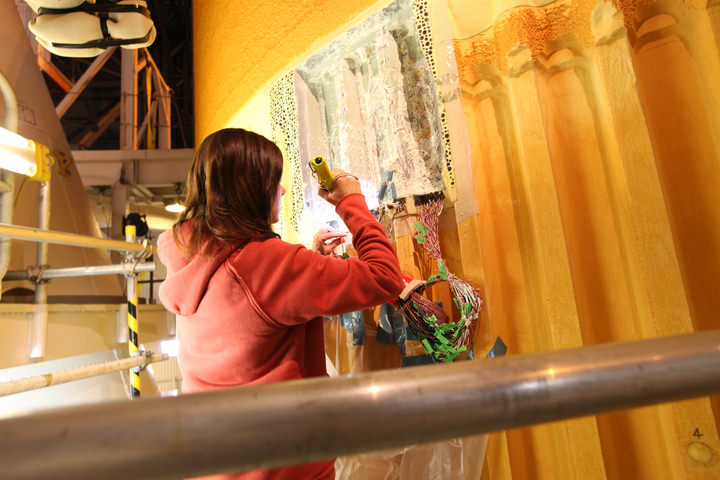
A technician begins to remove thermal sensors and foam insulation from space shuttle Discovery's external fuel tank in the Vehicle Assembly Building. Photo Credit: NASA/Frank Michaux
Discovery’s woes deepened this week with NASA engineers finding even more cracks in the orbiter’s external tank. The first crack was noted shortly after a leak was discovered on the Ground Umbilical Carrier Plate (GUCP) Nov. 5. After the first crack was found, technicians found a second and then a third. NASA found the crack on support beams dubbed ‘stringers’ around the intertank region of the tank. They applied what is known in the business as a doubler, a section of metal that is twice as thick as the original – this is done to strengthen the affected area.
On Dec. 17, a tanking test was conducted on the tank. Some 89 instruments were attached to the outside to monitor the tank as it was filled with super-cold liquid oxygen and hydrogen. The external tank can shrink by as much as an inch when these extremely cold liquids enter the tank. As one might imagine, this creates great stress on the tank, as such mission managers had the orbiter rolled back into the Vehicle Assembly Building (VAB) for X-Ray scans and other tests.
These tests are considered to be ‘non-destructive’ but NASA is not able to conduct them out at launch complex 39A. Testing started as soon as the full stack consisting of the orbiter, ET and twin solid rocket boosters were in the VAB.

It is unknown when Discovery will be back at LC39A for her final mission, STS-133. Photo Credit: Alan Walters/awaltersphoto.com
However, once these scans were completed – NASA had more problems, more cracks were found. Four cracks were found hiding beneath the foam on the side of the ET that faces away from Discovery. Mission managers will now weigh whether-or-not they will go ahead with repairing the damaged section of the ET. They are scheduled to make a final determination on Monday, Jan. 3. If they elect to do so, the repairs will be conducted inside of the VAB and not out at the pad.
STS-133 is a resupply flight to the International Space Station (ISS). When it does launch, it will carry the modified Leonardo Permanent Multipurpose Module (PMM) to the orbiting outpost. Contained within that is the first human-like robot to fly into space – Robonaut-2 (R2). Currently, Discovery is scheduled to launch no-earlier-than Feb. 3 at 1:37 EDT. This mission will mark the 39th time that Discovery has taken to the Florida skies and will be the final scheduled mission in the orbiter’s career.

Discovery's final crew may have to wait a while longer before they can start their mission. Image Credit: NASA
January 1, 2011
Happy New Year
Happy New Year everyone.
Hope we have clear skies through out the year and also get more breakthroughs in astronomy, astrophysics, rocket science, etc.
Hope we have clear skies through out the year and also get more breakthroughs in astronomy, astrophysics, rocket science, etc.
December 31, 2010

Gorgeous 3 D Vistas of Martian Crater and Hydrate Minerals at Santa Maria
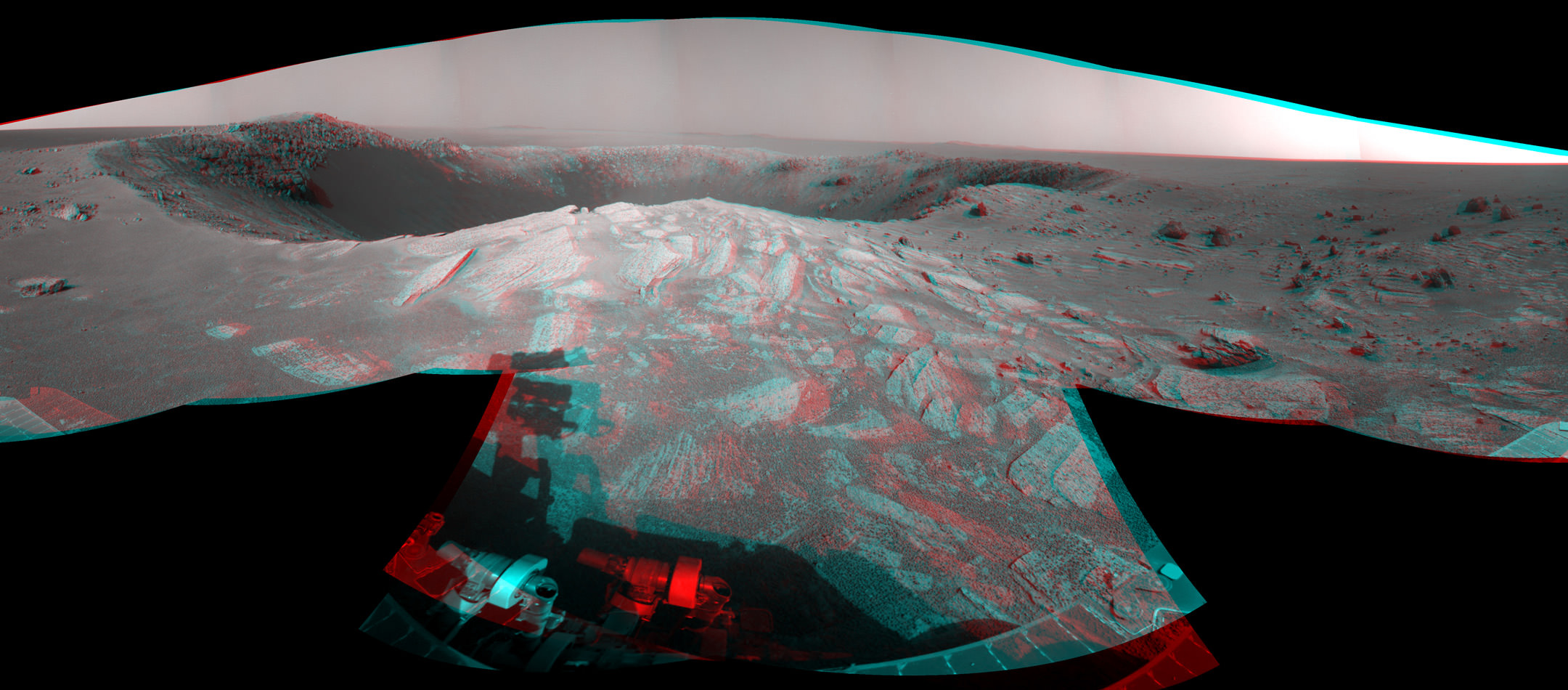
Santa Maria Crater in 3 D on Sol 2451.
Santa Maria is a football-field-size crater - about 90 m wide and 12 m deep - which dominates the scene in this stereo view from NASA's Opportunity rover. Opportunity sits about 5 meters from the steep western edge of this scientifically interesting impact crater which displays signatures of water bearing minerals at the center of this mosaic. Opportunity arrived here on the 2,451st Martian day, or sol, of the rover's work on Mars (Dec. 16, 2010). The rover used its navigation camera to take the frames combined into this mosaic. The scene appears three-dimensional when viewed through red-blue glasses with the red lens on the left. It combines images taken with the left eye and right eye of the navigation camera. Credit: NASA/JPL/Cornell.
Santa Maria is a football-field-size crater - about 90 m wide and 12 m deep - which dominates the scene in this stereo view from NASA's Opportunity rover. Opportunity sits about 5 meters from the steep western edge of this scientifically interesting impact crater which displays signatures of water bearing minerals at the center of this mosaic. Opportunity arrived here on the 2,451st Martian day, or sol, of the rover's work on Mars (Dec. 16, 2010). The rover used its navigation camera to take the frames combined into this mosaic. The scene appears three-dimensional when viewed through red-blue glasses with the red lens on the left. It combines images taken with the left eye and right eye of the navigation camera. Credit: NASA/JPL/Cornell.
Spectacular new images of a gorgeous gaping hole on Mars are streaming back to Earth from NASA’s Opportunity Mars Rover. So let’s take a 3 D stroll placing all of us at Santa Maria Crater – “On Mars”. Via the photo mosaics above and below, we will circle in three dimensions about the stunningly beautiful Santa Maria Crater. At the southeast portion of the rim, the crater also possesses a scientific goldmine of hydrated mineral deposits. These minerals are indicative of the past flow of liquid water on Mars, an essential requirement for the formation of life.
Opportunity made landfall at the western edge of Santa Maria on Dec. 15 (Sol 2450) after a long and arduous journey of some 19 km since departing from Victoria Crater over 2 years ago in September 2008. She crawled closer to the rim the next day on Dec. 16 (Sol 2451) unveiling a magnificent vista of jumbled ejecta rocks, steep sloped cliffs and undulating sand dunes across the crater floor.
“Santa Maria is a relatively fresh impact crater. It’s geologically very young, hardly eroded at all, and hard to date quantitatively. On the order of 10 million years old or less,” said Ray Arvidson in an interview from Washington University in St. Louis. Arvidson is the deputy principal investigator for the Spirit and Opportunity rovers.
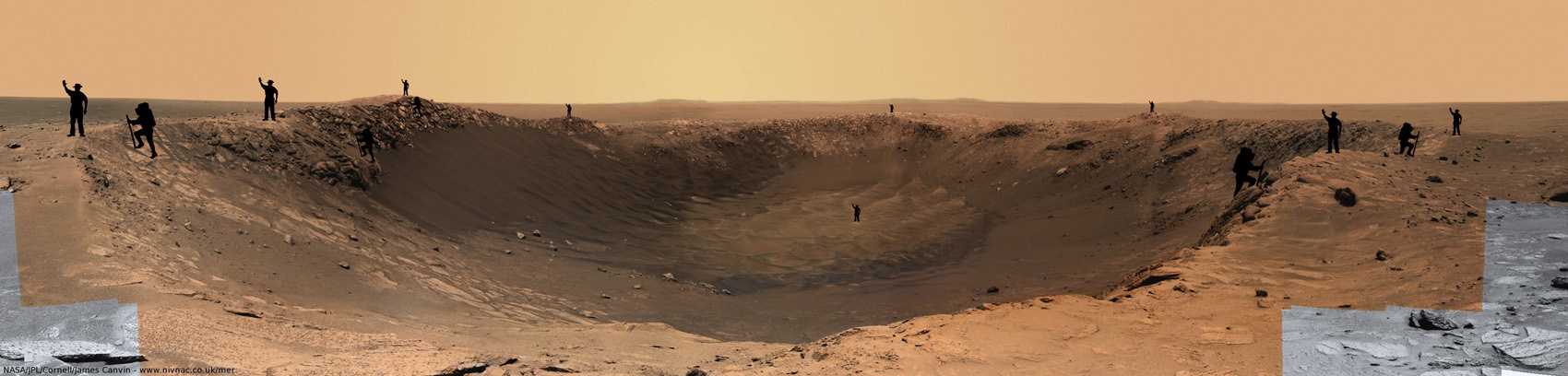
Santa Maria from Palos Promontory on Mars.
Imagine yourself at the steep cliff walls of Santa Maria crater at a place called Palos. To get a sense of scale in 2 D, human sized figures (2 m tall) have been strategically placed at multiple locations near and far, around and inside this gorgeous panoramic vista. Opportunity drove closer and snapped these images just 2.5 meters from the crater’s edge on Sols 2453 & 2454. Mosaic Credit: NASA/JPL/Cornell, James Canvin. Annotations of Mysterious men in black hats and their cousins, the French climbers by FredK and ElkDanGrove at unmannedspaceflight.com
Imagine yourself at the steep cliff walls of Santa Maria crater at a place called Palos. To get a sense of scale in 2 D, human sized figures (2 m tall) have been strategically placed at multiple locations near and far, around and inside this gorgeous panoramic vista. Opportunity drove closer and snapped these images just 2.5 meters from the crater’s edge on Sols 2453 & 2454. Mosaic Credit: NASA/JPL/Cornell, James Canvin. Annotations of Mysterious men in black hats and their cousins, the French climbers by FredK and ElkDanGrove at unmannedspaceflight.com
“Santa Maria is the freshest big guy that Opportunity has seen and has a raised rim,” Arvidson told me. “It is much younger than Endurance Crater which Opportunity visited a few months after landing on Mars way back in 2004 and is roughly the same diameter.” See the entire Opportunity traverse map below.
“The crater is young enough that the interesting hydrate outcrops may not be coated with the nanophase iron oxide dust. There is virtually no erosion. We can see the ejecta rays and blocks,“ said Arvidson.
While sitting just five meters from the rim on Dec. 16, Opportunity imaged the football field sized crater – some 90 m wide – with both its left and right eye navigation cameras. A mosaic of these images was stitched together by NASA to create a stunning 360 degree stereo panoramic vista. The images are snapped from the same height seen by an adult to give the perspective that a human eye would see when standing “On Mars”.
The crater is the centerpiece of the stereo image above, which shows the crater’s sharp rim and rocks ejected from the impact that had excavated the crater. You will need to whip out your red-cyan stereo glasses to experience the full three-dimensional effect of the scene. Be sure to wear the red lens on the left, and try not to fall off the cliff.
Click here for the entire 360-degree high resolution stereo view – its 10 MB in all. South is at the center. North is at both ends. The view is presented as a cylindrical-perspective projection. The wheel tracks left behind in the Martian dirt – as the rover approached the crater – are seen at the far right and are also highlighted in our 2 D mosaic below.

Off in the distance, several portions of the rim of Endeavour Crater are visible as bumps on the horizon. Endeavour is the ultimate target of Opportunity’s long term trek across the Martian dunes at the Meridiani Planum region and is some 22 kilometers in diameter.
“Endeavour shows significant signatures of phylloslicates, or clay minerals, and water bearing sulfate minerals which formed in the presence of liquid water,” Arvidson explained. “The phyllosilicates formed at the crater rim about 3.8 to 4.2 Billion years ago and predate the sedimentary rocks which are younger than 3.8 billion years.”
Pictured below is a collection of stereo photo mosaics for a North to South up close tour around the rim of Santa Maria. Several of the images were created by members of unmannedspaceflight.com.
“Opportunity will drive in a counterclockwise direction around Santa Maria to reach the very interesting hydrated sulfates on the other side. We’ll make 3 stops or more depending on what we see”
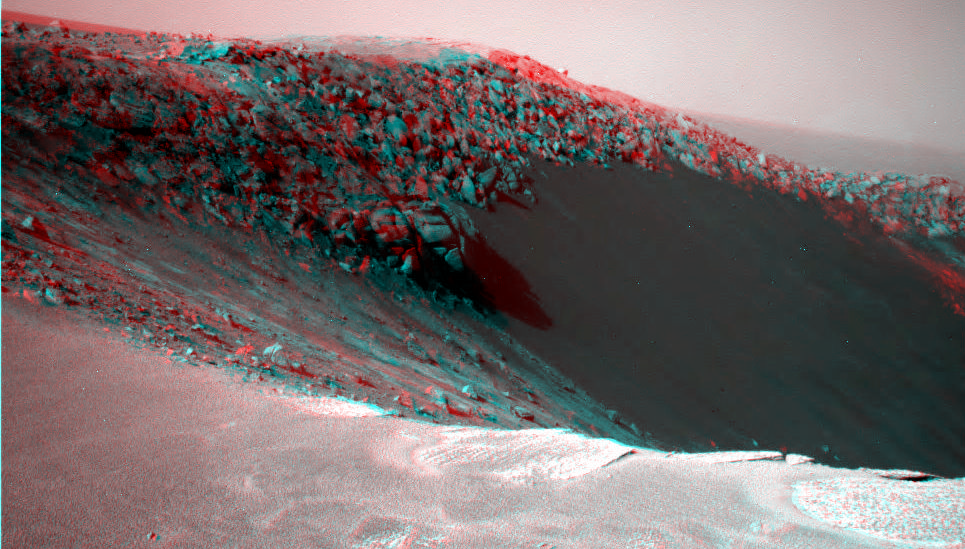
Stereo view of the sharp northern rim of Santa Maria on Sol 2451. Credit: NASA/JPL/Cornell/Stu Atkinson
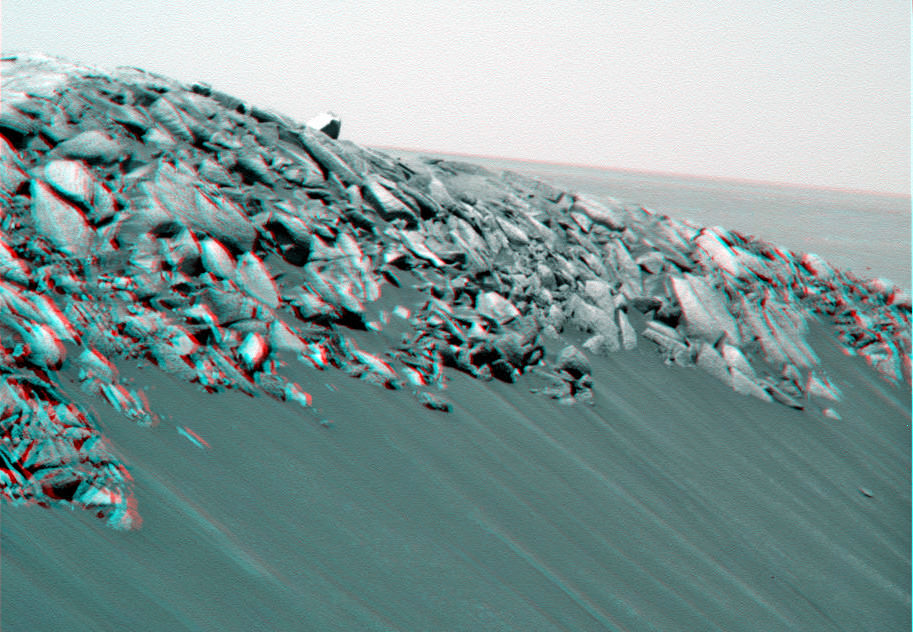
Convoluted martian rocks in 3 D close up at the sharp northern rim of Santa Maria. Credit: NASA/JPL/Cornell/Walfy at unmannedspaceflight.com
“On Dec. 19 (Sol 2454) we bumped the vehicle even closer to the rim from the initial approach point, to a promontory we’ve nicknamed ‘Palos’, stated Arvidson. “Opportunity was a mere 2.5 meters from the edge. At ‘Palos’, the rover collected the first set of long baseline, high resolution stereo images for creating a 3 D digital elevation map.”
“The coves at Santa Maria will be named after the islands which Columbus visited, using the native American language. All the rocks and boulders strewn about will be named after the sailors on the voyage with Columbus,” explained Arvidson.
“This past weekend we drove about 20 meters southeast towards the second location named ‘Wanahani’. On Tuesday of this week (Dec. 28) we bumped to the edge. The plan is to photograph the ejecta rocks and collect the next set of long baseline, high resolution stereo images.”
The third stop – which must be reached before Solar Conjunction in mid January 2011- will take Opportunity to the science hot spot detected by the powerful CRISM mineral mapping spectrometer circling above Mars aboard NASA’s Mars Reconnaissance Orbiter (MRO).
“With CRISM we are trying to cover all the rim segments to better understand the nature and geologic setting of the iron and magnesium smectite clay mineral exposures. The southeast portion of Santa Maria is generally the location of the CRISM spectra that show hydrated sulfates. Opportunity will go to the southeast rim and try and find a nice outcrop on the rim side to do measurements to field verify the expected mineralogy,” explained Arvidson.
“We might do a toe dip with the wheels but there is no plan to go inside.”
“We will use the Rock Abrasion Tool (RAT) to drill into a selected target. That spot will be named after ‘Columbus’.
The exposures of hydrated sulfates have a bright toned appearence in the images.
“With the sun over the camera’s shoulder there is a phenomenon called opposition effect in which rocks and soils become particularly bright when the sun-camera-surface line up, Arvidson told me. “But, it also may be that the bright looking rocks are intrinsically bright and not coated with the nanophase iron oxide coatings we have seen on previous outcrops. All in the realm of testable working hypotheses.”
“On Dec. 30 we are planning another CRISM spectral mapping campaign with MRO over Santa Maria,” said Arvidson. “Using a new technique which gimbals, or swivels, the CRISM optics we hope to use a pixel overlap technique to improve the ground resolution from 18 meters across to 6 meters across. This data will be used in tactical decisions about where to drive on Mars.”
Read more of my interview with Ray Arvidson in the next feature story describing the exciting plan for science exploration at Santa Maria and Endeavour, the outlook for Spirit and more – along with new mosaics from “Wanahani”.

Hydrated Sulfates in 3 D at Santa Maria.
This cropped 3 D segment shows the location of the bright toned exposures of hydrated sulfate minerals detected inside the southeast rim of the steep walled crater. Deposits of hydrated sulfates are an indicator of the past flow of liquid water on Mars. They were detected from orbit by the CRISM mapping spectrometer aboard NASA’s Mars Reconnaissance Orbiter (MRO). Opportunity will go to the SE rim and try to do measurements to field verify the expected mineralogy. Credit: NASA/JPL/Cornell
This cropped 3 D segment shows the location of the bright toned exposures of hydrated sulfate minerals detected inside the southeast rim of the steep walled crater. Deposits of hydrated sulfates are an indicator of the past flow of liquid water on Mars. They were detected from orbit by the CRISM mapping spectrometer aboard NASA’s Mars Reconnaissance Orbiter (MRO). Opportunity will go to the SE rim and try to do measurements to field verify the expected mineralogy. Credit: NASA/JPL/Cornell
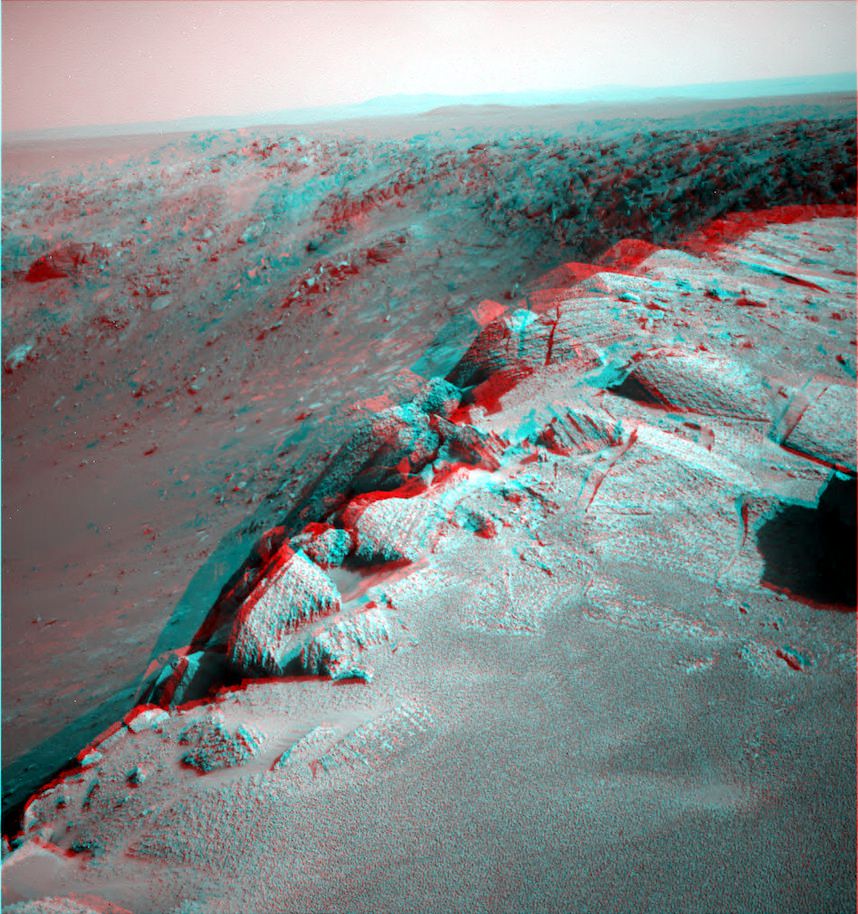
Looking in stereo to the steep walled southern rim of Santa Maria.
Opportunity will drive to the south rim in January 2011. Cape Tribulation is in the background and located at the western rim of the huge Endeavour Crater which possesses deposits of clay minerals, or phyllosilicates, which form in the presence of neutral liquid water. Cape Tribulation is about 100 meters tall. Credit: NASA/JPL/Cornell/NickF at unmannedspaceflight.com
Opportunity will drive to the south rim in January 2011. Cape Tribulation is in the background and located at the western rim of the huge Endeavour Crater which possesses deposits of clay minerals, or phyllosilicates, which form in the presence of neutral liquid water. Cape Tribulation is about 100 meters tall. Credit: NASA/JPL/Cornell/NickF at unmannedspaceflight.com
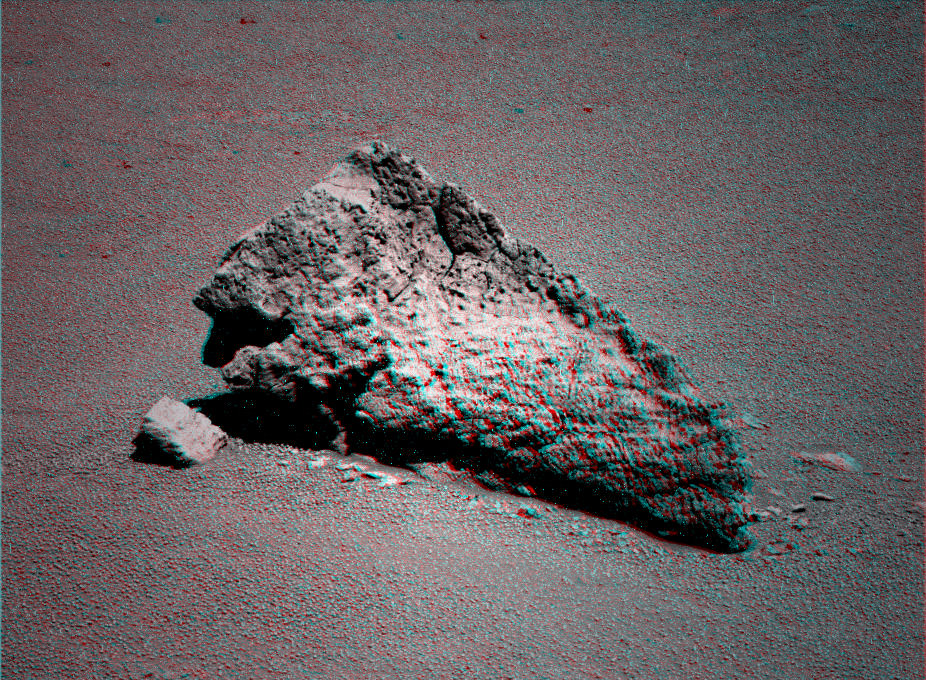
‘Crocodile Tail’ in 3D.
Opportiunity drove past this amazing looking ejecta rock at the outskirts of Santa Maria Crater while approaching the rim. Credit: NASA/JPL/Cornell/Stu Atkinson
Opportiunity drove past this amazing looking ejecta rock at the outskirts of Santa Maria Crater while approaching the rim. Credit: NASA/JPL/Cornell/Stu Atkinson

Rover wheel tracks on Mars
This mosaic of images from Sol 2451 (Not in 3 D) shows the tracks from Opportunity’s wheels on the approach to the steep crater rim on Sol 2450. Credit: NASA/JPL/Cornell, Marco Di Lorenzo, Ken Kremer
This mosaic of images from Sol 2451 (Not in 3 D) shows the tracks from Opportunity’s wheels on the approach to the steep crater rim on Sol 2450. Credit: NASA/JPL/Cornell, Marco Di Lorenzo, Ken Kremer
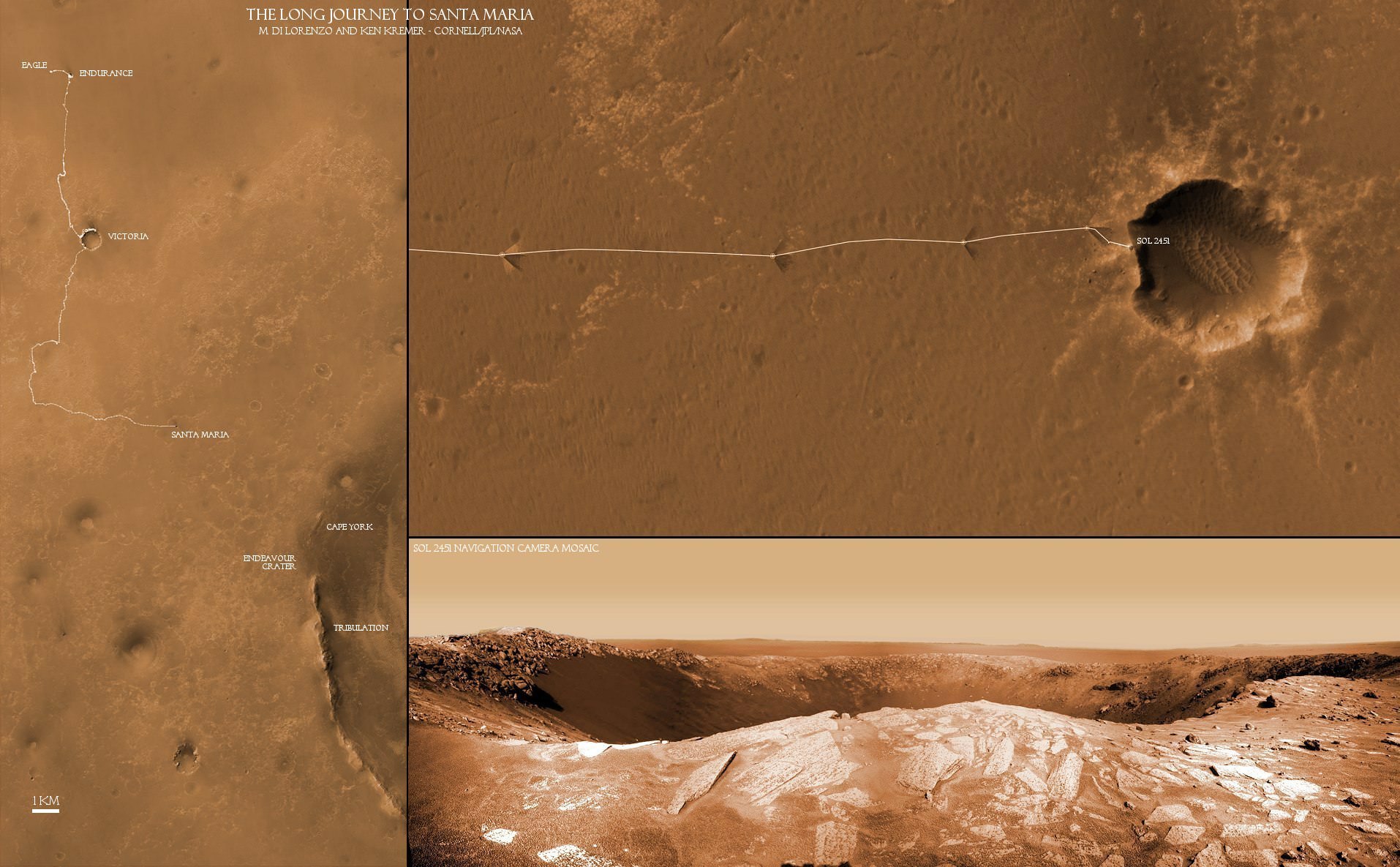
The Long Journey to Santa Maria:
This collage of two maps and a 2 D close up panorama of Santa Maria crater (bottom right) shows the route traversed by the Opportunity Mars rover during her nearly 7 year long overland expedition across the Meridiani Planum region of Mars. Opportunity arrived at the rim of Santa Maria Crater on Dec. 16, 2010 on Sol 2451 and will drive around the edge in a counterclockwise direction to examine rocks which are indicative of the past flow of liquid water. The next destination is Endeavour Crater - some 22 km wide - to investigate water bearing minerals at Cape York and Cape Tribulation which she will reach sometime in 2011. Credit: NASA/JPL/Cornell, Marco Di Lorenzo, Ken Kremer
This collage of two maps and a 2 D close up panorama of Santa Maria crater (bottom right) shows the route traversed by the Opportunity Mars rover during her nearly 7 year long overland expedition across the Meridiani Planum region of Mars. Opportunity arrived at the rim of Santa Maria Crater on Dec. 16, 2010 on Sol 2451 and will drive around the edge in a counterclockwise direction to examine rocks which are indicative of the past flow of liquid water. The next destination is Endeavour Crater - some 22 km wide - to investigate water bearing minerals at Cape York and Cape Tribulation which she will reach sometime in 2011. Credit: NASA/JPL/Cornell, Marco Di Lorenzo, Ken Kremer
Subscribe to:
Posts (Atom)